What skills do you need to become a space architect?
This is a question I get a lot from architecture students and practitioners interested in exploring a space architecture career path. So what’s the difference between a space architect and an ‘Earth’ architect? Recently I’ve heard answers ranging from “space architecture is just a version of regular architecture” to “it’s completely different.” But I think it’s a bit of each.
In one sense, the process of designing for space is similar to designing a building. Establishing a concept, understanding the context and environment, working within constraints, juggling competing priorities, integrating multiple systems, and meeting a budget and schedule are all common between architecture and aerospace. Many of the tools end up being similar, from sketching to spreadsheets to different CAD tools to visualization and presentation. The project work is broken into phases with milestones gating progress. The core design idea has to make sense from an engineering standpoint, be optimizable across different dimensions, and ultimately be feasible and practical to build.
However, the specific, practical knowledge that’s needed for designing in space is quite different from that of building things on Earth. Where building architects need to be able to approximate structural systems, vertical circulation sizing, HVAC needs, and much more, there ends up being little crossover to a microgravity environment where the primary structure is a pressure shell, “vertical” circulation is accomplished via floating, and HVAC must operate with no outside air or inside convection. Even areas that would seem to transfer — the anthropometric dimensions of a human operating in an environment, for example — have to be rethought when gravity disappears and physical volume comes at a premium. Sometimes the simplest thing, like where to place a smoke detector, needs a first-principles treatment.
In my mind, one of the keys to being a space architect is retaining the process skills, the ability to creatively ideate and solve design problems, while absorbing and incorporating an entirely new context and knowledge base.
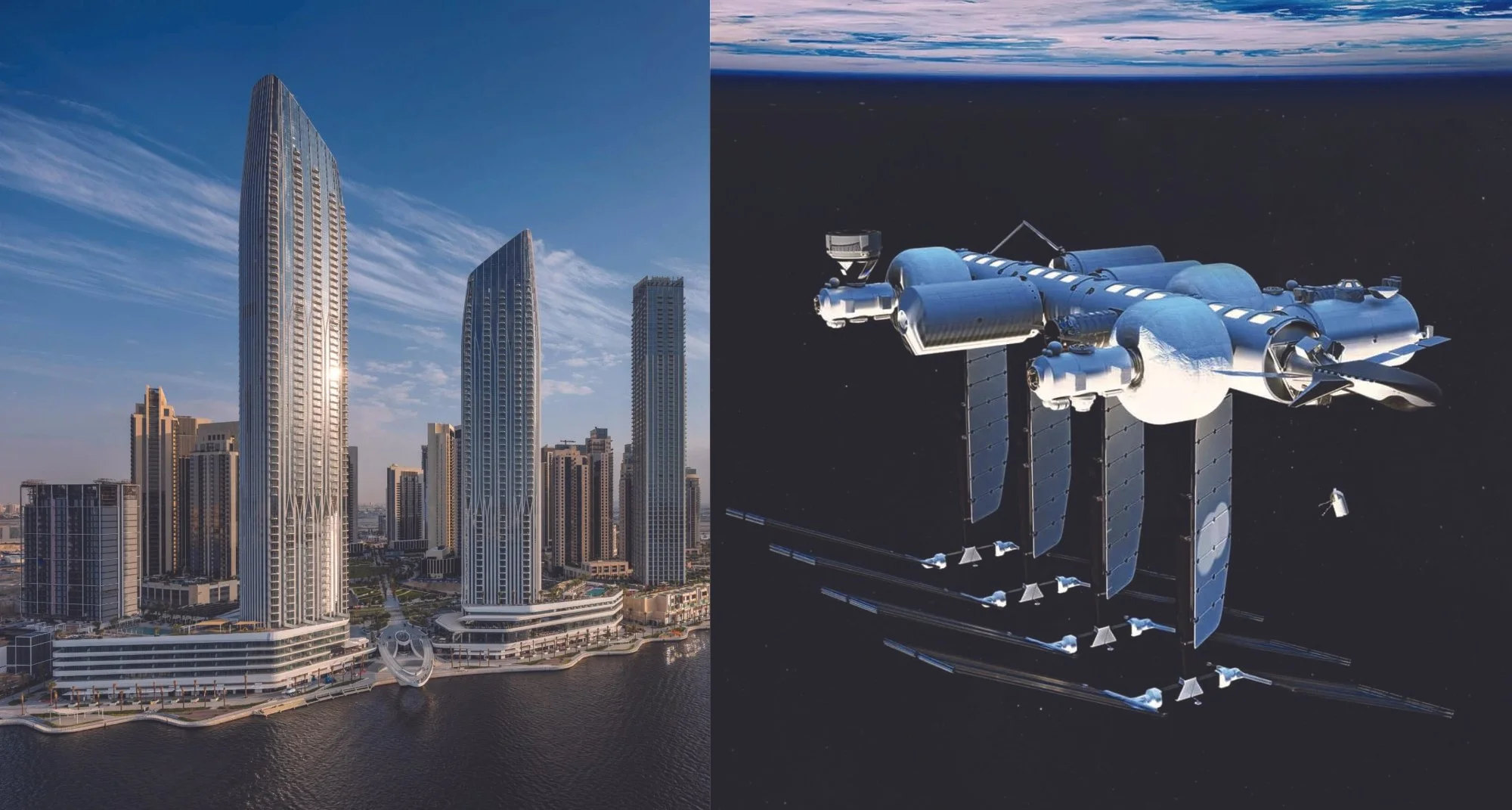
Images: CannonDesign; Blue Origin