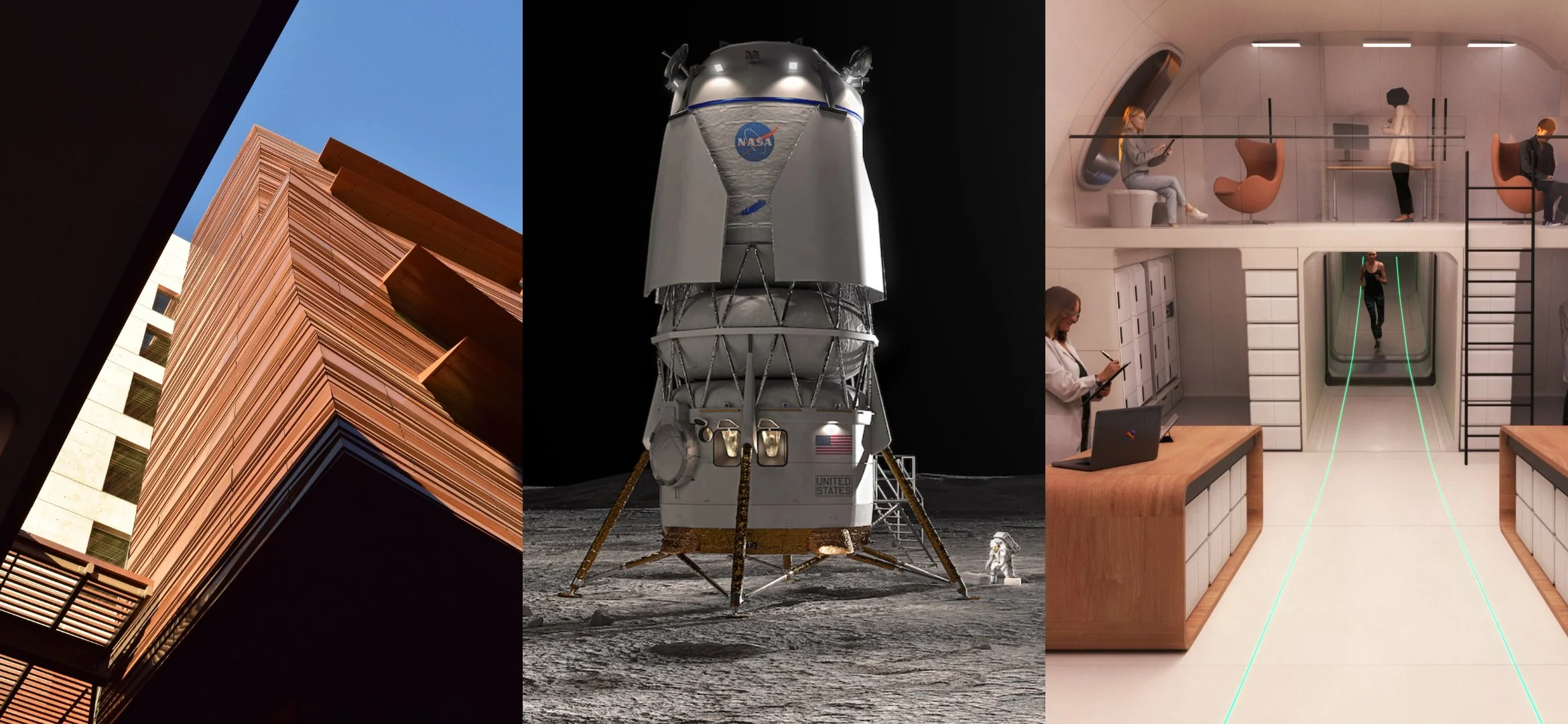
Three Realizations About Architecture
In my experience going to school for architecture, working in the field, leaving the profession, then coming back, earning my license, and starting my own practice, I’ve had three big moments where I realized something profound, or at least profound to me, about architecture. These realizations have come to shape the way I think about the profession and my relationship to it, as well as how I’ve approached starting my practice and how that thinking has evolved over just a few months.
My first realization occurred while working on a mid-sized project that required a lot of technical expertise and watching the architecture team hand over a huge amount of scope to our engineering consultant. Structural, mechanical, electrical, plumbing, and civil are pretty common, as are a few others these days, like data, audio/visual, and acoustics. But we also handed off facade design, fire & life safety, sustainability, code compliance, and cost estimation, some of which are arguably core to what an architect does. And this particular case also included me getting told “we are not cost estimators” when trying to push for design ideas that would optimize for cost constraints. This is when I first started to question what value architects really bring to the table in a building project. Long gone are the days of master builders, but did the engineering team even need us? Were we just providing window dressing for windows designed by a facade consultant? Did we provide a design concept that somebody else had the knowledge and capability to actually execute?
Second was working at a really strong interiors, residential, and hospitality studio, where oftentimes the design intervention boiled down to selecting finishes and products and arranging them in the space, then writing a specification that tells the client where to buy them. In aerospace this would be a pure COTS approach, assembling a collection of Commercial Off The Shelf products into your vehicle. This is when I first started thinking architecture maybe wasn’t for me because, while I recognized this was a valid design approach, it didn’t personally feel like I was creating something new in a way that interested me. Similar to my first realization, this relegated the design process to something that was limited in its ability to shape the built environment and was ultimately unsatisfying to me.
My third realization didn’t happen until I left architecture practice to work as an aerospace systems engineer. Working on space habitats was, ironically enough, probably the first time I started to care about interior architecture. I had spent my time in architecture focused on facades, massing response to context and environmental conditions, and overall building planning and programming. But in space vehicles, everything is so necessarily constrained that interiors become the only point of human interface, and the way they are designed is more detailed, bespoke, and demanding than nearly anything on Earth. And because there are only a handful of precedents and no meaningful supply chains, you have to figure out everything yourself, including sourcing, manufacturing, integration, and testing. There is more responsibility and more control over the outcomes.
So what does it mean to build and operate an architectural practice that takes more agency and more of a first principles approach? While establishing what I wanted The Space Age to be and do, these questions and ideas were always in the back, or front, of my mind, and they continue to be today. At minimum it means leaning in to that responsibility and figuring out more yourself, or working with partners who can help. It also means designing within a product context, treating what you deliver as the actual built space, not a set of drawings or design documents. Think about Apple designing the first iPhone, F1 teams customizing car parts, or the materiality and geometry of the fuselage of a high-performance jet. There’s an element of extreme ownership over the performance of the final product, but also a tendency toward the unusual problems solved by one-offs and prototypes, a departure from commoditization.
For those who have been following along for the last few months (thanks!), you’ve likely detected a shift in the way I talk about The Space Age, the problems we solve, the work we do, and how we generally engage with the world. When we launched, we were All Space All the Time. Today, we’re settling into a broader but more nuanced approach that recognizes where we can do the most good: those unusual problems or circumstances where prototyping can have the greatest impact; the projects where depth of expertise in a particular building type doesn’t necessarily translate into a viable solution; the clients and users trying to accomplish something for the first time and are in need of an entirely different approach from what’s been done before. Without question, future space habitation fits into that context, but it’s just one part of a bigger, richer picture.
This is all work in progress, so stay tuned as we continue refine and figure things out.