
CASE STUDY
A Framework for Collaborative Research
Biomedical Sciences Partnership Building
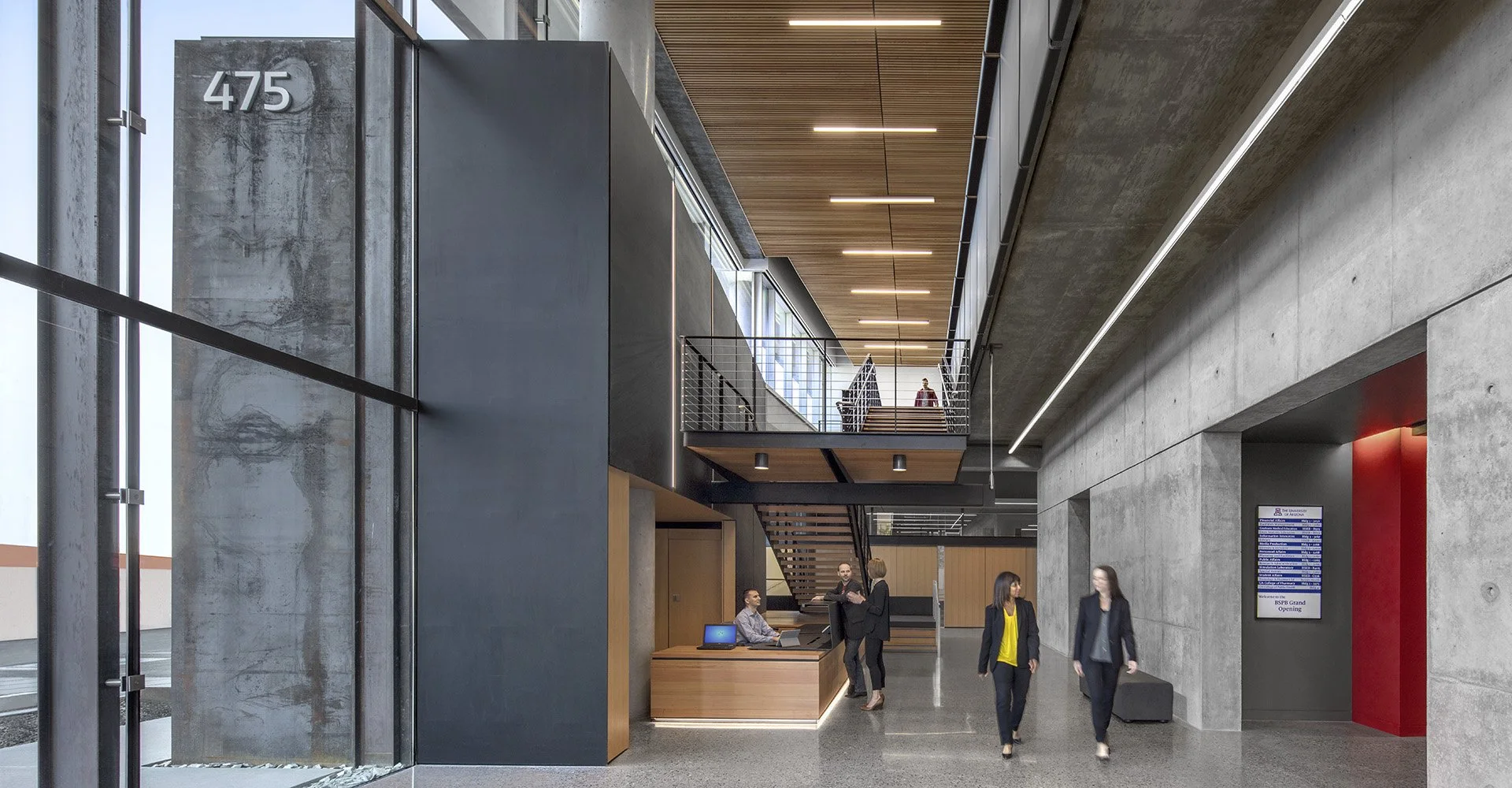
A base for collaborative clinical and translational research that enables the discovery of innovative solutions to today’s most pressing health issues.
BSPB supports ongoing research initiatives at the heart of Arizona’s Biosciences Roadmap, organized into Centers of Excellence for cancer biology, neuroscience, traumatic brain injury, bioengineering, and public health informatics.
Work completed with CO Architects and Ayers Saint Gross. Photos by Bill Timmerman.
PRACTICE AREA: SCIENCE & TECHNOLOGY
CAPABILITIES:
Programming
Laboratory Planning
Interior Layout & Design
Facade Design & Fabrication Support
Human Centered Design
Completed in 2018, BSPB is a 10-story, 245,000 square foot academic research lab located on the University of Arizona’s 28-acre Phoenix Biomedical Campus. The project was completed on a contractor design-assist schedule and achieved LEED Silver certification.
Read the Dezeen project feature
Designed to adapt to the particular needs of future users, the building is organized as a framework of modular lab spaces and supporting program elements.
Each lab floor accommodates different wet, dry, and flex lab configurations with minimal additional tenant-improvement work needed.
Pairs of adjacent lab floors share social spaces for meetings and collaboration, including a small kitchen.
The ground floor supports an academic conference center and the top floor holds an administrative suite.
Awards
Architizer, 2019 People’s Choice Award in Metal + Architecture
The Architect’s Newspaper, 2018 “Best of” Design Awards
The Chicago Athenaeum: Museum of Architecture & Design, 2018 American Architecture Award
AZRE Magazine, 2018 AZRE Red Awards
American Architecture Prize, 2017 Honorable Mention in Architectural Design
World Architecture Festival, 2017 Finalist
ENR, 2017 Best of the Best Award
AIA California Council, 2018 Honor Award
An addition to an adjacent medical school building, BSPB expanded the formal complexity of the existing facade and copper panel cladding system while incorporating computational logic and shading strategies that contributed to the building’s LEED Silver certification.

We can do things that we could not do elsewhere because we have [this] unique environment. It’s state of the art, and I think already people are coming from many different countries (and) are very impressed by the building and the facilities. It’s a very good environment to stimulate (creativity) and innovation.
Frederic Zenhausern, PhD, MBA
Director, Applied Nanobioscience & Medicine, University of Arizona College of Medicine, Phoenix