Sustainable Space Habitation
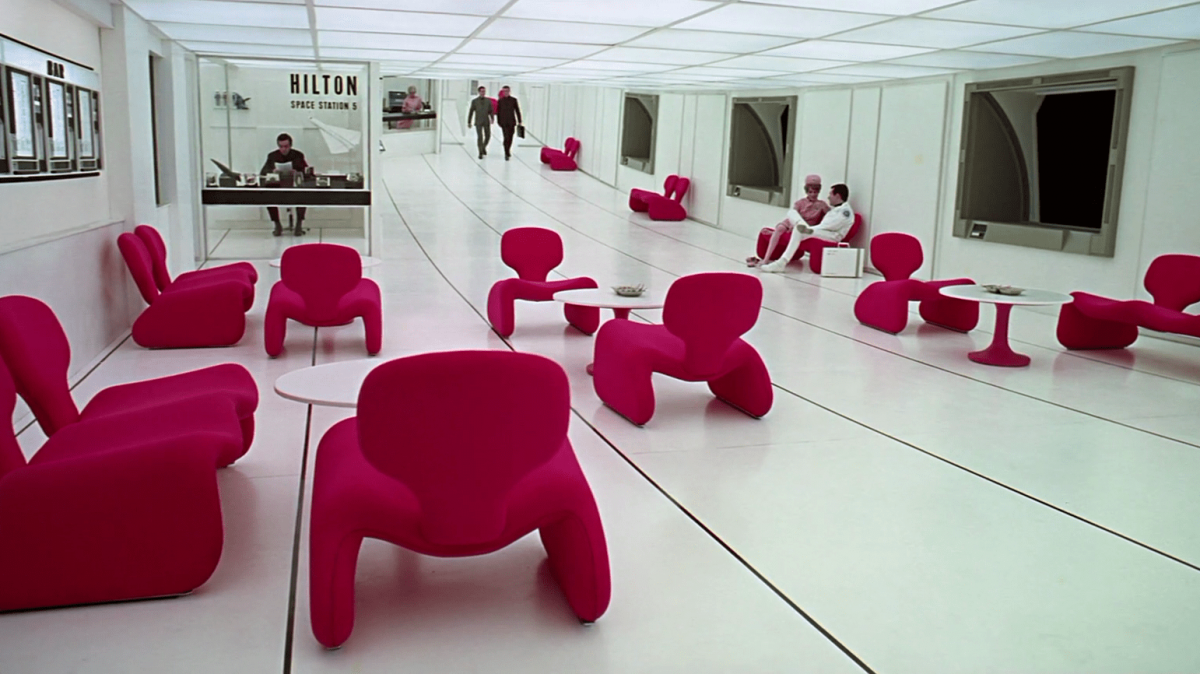
Hilton Space Station 5 from 2001: A Space Odyssey (Metro-Goldwyn-Mayer)
Most who know me know that I’m interested in the permanent, sustainable habitation of space. That means long-term habitats designed for spacefarers who are not just visiting for days, weeks, or months, but living and working for years. It means designing for a human experience that goes beyond merely surviving and accommodates well-being and quality of life the way architecture can on Earth.
That likely looks different from today’s state of the art. Space systems engineers are accustomed to designing a minimum viable product, flying as little mass, power, and volume as possible to efficiently achieve mission objectives. This makes perfect sense — going to space is challenging and expensive, and the constraints involved drive us to an expeditionary mindset. Meals are pre-packaged then rehydrated. Clothes are worn for days, then trashed. Bathing is accomplished via wet wipes. Sure, camping is fun for a while — the pros outweigh the cons — but it’s probably not how you’d choose to spend 10 years of your life.
Extreme environments on Earth, such as Antarctic bases, are an excellent analog for short-term explorers, visitors, and workers in space, and there are many transferrable lessons. But what I’m suggesting isn’t a slightly better version of life in space as we know it. Long-term space habitation by ordinary people will need to look dramatically different, a qualitative shift rather than an incremental improvement.
Space architects are tasked with imagining a better built environment in space while staying reasonably within the bounds of the engineering challenges constraining habitat design. Design quality will play an pivotal role in enabling human well-being in space, which is possibly the key driver for new kinds of space architecture.
As they do for buildings on Earth, architects can offer a holistic vision for space habitats, as well as a strategic framework through which the broader design team can work to realize that vision. This approach capitalizes on designers’ comfort with ambiguity and a recognition that human experience is rarely understood in discrete, decomposable pieces, but rather is the amalgamation of many, sometimes conflicting factors.
It’s a little upsetting to me that after nearly 60 years of spaceflight the Earth to Moon infrastructure portrayed in 2001: A Space Odyssey remains one of the most compelling visions we have for life in space in the near future. I believe we’re nearing an inflection point where much of this is starting to become achievable, but more design exploration is needed to bridge the gap between that kind of vision and engineering reality. I’m excited to help shape an updated, optimistic, and practical vision for living and working in space.