In a previous post, I compared the project delivery frameworks predominantly used in aerospace and architecture projects. In this one I’m going to look at two design process frameworks that are utilized more broadly and have more possibility for explicit overlap: the Double Diamond design framework and the Systems Engineering V-diagram.
I say ‘possibility’ for overlap because functional overlap in practice is actually pretty unlikely, for reasons we’ll see below. And because that’s the case, I’ll briefly describe each framework then compare and contrast.
The Double Diamond
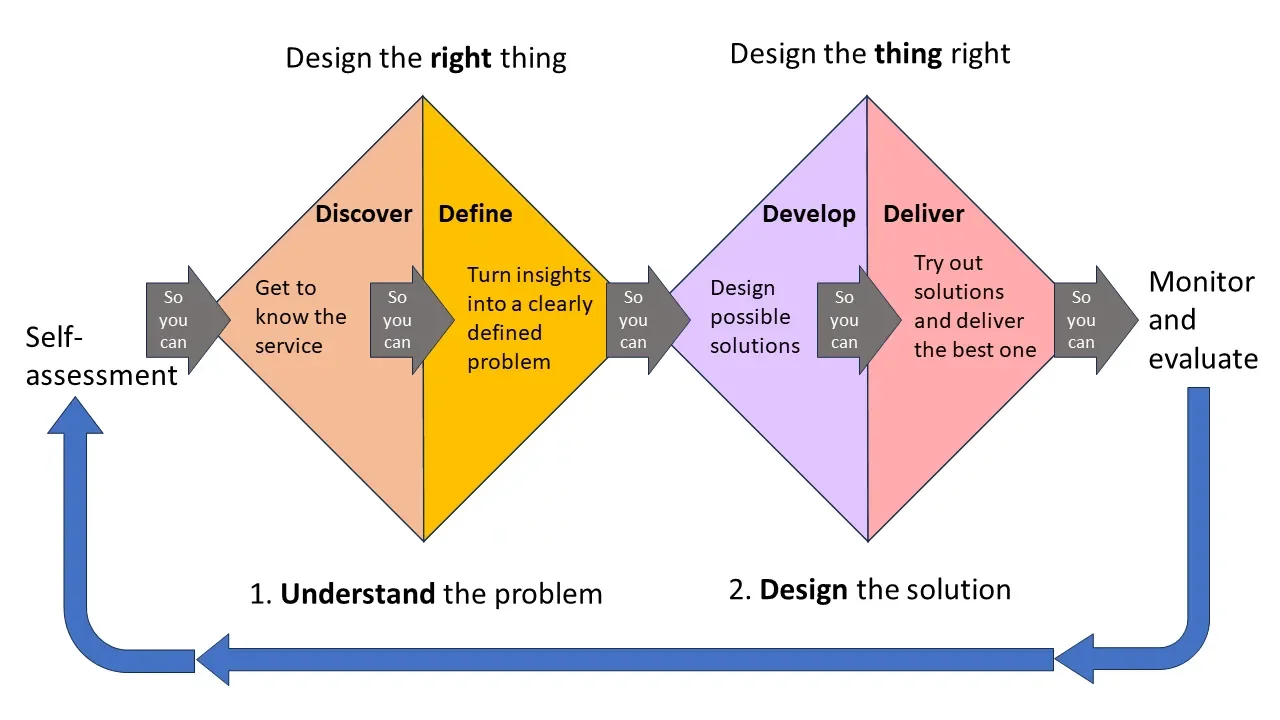
The Double Diamond Design Framework is intended to capture the process of design thinking. There a quite a few variations of this diagram out there, but I picked this one because it uses a tiny bit of systems engineering language, making my comparison a little easier.
The process unfolds in two big steps and four phases: understand the problem through the discover and define phases, then design the solution in the develop and deliver phases. The shape of each phase helps describe whether that part of the process is divergent or convergent — going wide like you would when brainstorming vs. zeroing in like you’re solving a math problem. The Discover phase goes wide to help everyone learn about the design problem. Define collects insights from Discovery to bound and characterize the problem. Develop is a generative and collaborative phase to explore design ideas. Deliver tests and narrows the solution space to arrive at viable solutions.
Though presented linearly, each phase is intended to be iterative, as is the entire process itself.
Systems Engineering “V”
The systems engineering V-diagram also has many different versions and is frequently adapted across different engineering fields. This one is from a NASA guide produced by Marshall Spaceflight Center.
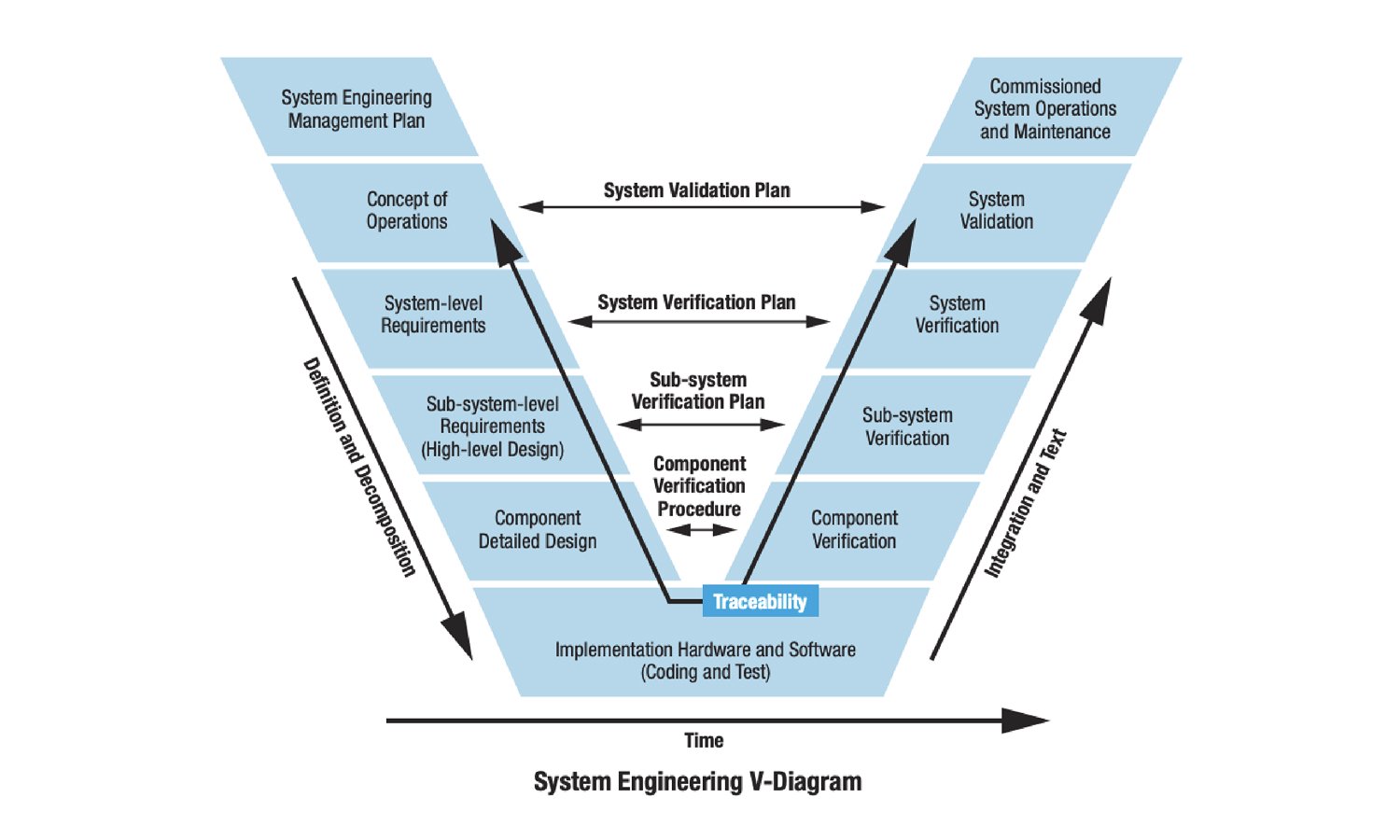
This diagram also reads left to right. Moving down the left side starts at high level plans and objectives, then gets more granular in defining requirements, system elements, and components. This gets a little jargony — it’s intended for engineers after all — but all this says is you start with a high-level idea of what you want to do, then iteratively break that idea down, asking “what does it take to…” for each part of the intended mission and product.
The right side of the diagram travels back up from the lowest level of implementation up to the completed system. This is the Integration and Test part of the process where all the components are slowly assembled into the final product with formal verification taking place throughout.
Verification is shown as the arrows pointing between the two sides of the V: the components and systems being integrated on the right side are verified against the relevant requirements formulated on the left side. This “roll-up” of verification is what tells you that your spacecraft is going to perform the way you intended.
Comparing the Diagrams
The frameworks have definite similarities, as well as important differences. Probably the first thing to note is that these processes are designed to ingest different inputs and arrive at different conclusions, especially in cases where a complete design may not mean a delivered product, as with architecture.
Here are a few similarities and differences that jump out to me.
Both are geometric. There’s no rule that says process diagrams need to have iconic geometry. Most process diagrams are boxes connected with lines. But both of these are not only characterized by imageable geometries, but actually use that geometry to describe process flow.
Both present as linear, but are really about iteration. Engaging with either process means following a linear path, but both also intentionally involve iteration as part of that path. One implication of this is that neither diagram can tell you how long the process will take.
The V-diagram includes process control. For instance, starting with the codification of the Systems Engineering Management Plan before anything else happens. This is where the V incorporates adaptability by explicitly asking you to write down the development process as step one.
The Double Diamond starts with a question. Where the V-diagram dives right in to analytical decomposition, the Double Diamond starts by asking for a more contextual understanding of the problem, maybe even redefining the problem along the way.
The V-diagram has more structure; the Double Diamond has broader applicability. Where the rigor of the V-diagram is tuned for the engineering domain, the Double Diamond is not intended for a particular field or industry and can be looser and more adaptable.
These differences are probably not a surprise. Engineering design workflows require much more specificity over the resulting technical products; broad, creative design workflows need to accommodate a large degree of ambiguity and emphasize problem definition to constrain the design outcomes.
Takeaways: How the frameworks might work together
Going back to the idea of these overlapping, I think each framework exhibits gaps that can be partially remedied by the other. The Double Diamond exists at a high level. It’s intentionally simple and mutable, and while it can accommodate the kind of project controls driving the V-diagram, it doesn’t do so explicitly. Meanwhile, the V-diagram is a detailed system decomposition but doesn’t incorporate deep investigation of the core problem being solved.
Something else I mentioned earlier was that this particular version of the Double Diamond incorporates systems engineering language: “Design the right thing; Design the thing right,” is a colloquialism for validation and verification, respectively. It’s clear from the V-diagram that most of the right side is focused on verification and, as a result of that knowledge, the left side becomes about crafting verifiable requirements, systems, subsystems, and components.
Validation can be less procedural and may only occur once all the verification has stacked up near the end of the system integration effort, which can take years. Maybe an opportunity to inject some of the divergent approach of the Double Diamond.
I think these frameworks can be complementary, and that combining them can be a major value add for the right design problems. Architectural practice actually does a reasonable job of that, albeit without explicitly relying on these frameworks. User-facing technology products are maybe the clearest use case, whether it’s a laptop, smart phone, or a car.
Of course any design process attempting to integrate Design and Engineering would also need to integrate the designers and engineers. Easy for me to say: I’m both. But for a team that wants seamless handoffs between design and engineering, especially in an iterative development process, understanding what might be missing in each framework and how they can interface with each other has real value to both process efficiency and the success of the final design solution.
Sources
https://www.designcouncil.org.uk/resources/framework-for-innovation/
https://mycouncilworks.co.uk/service-design/double-diamond-model/
https://www.nasa.gov/reference/systems-engineering-handbook/