Here’s what modular design can look like in commercial space stations, if we design for it
The modular payload packaging approach systematized by the Shuttle Mid-deck Locker, then pushed further down the road of path dependency by the ISS, has defined on-orbit science for decades by ensuring the transportation constraints of the time were met. The resulting volume-constrained solutions have offered a minimum viable product to science principal investigators, but do not reflect the way research is optimally done on Earth.
Labs on Earth have similarly found their way to modularity, though driven by a different set of constraints: zoning and building codes define overall size and shape, structural grids define the open space on a floor, utilities drive floor-to-floor and ceiling heights. Lab casework and equipment is designed to fit into these systems, along with clearances for the humans to work.
It’s an accumulation of details that stacks up to define the architecture. Sometimes this is purposeful, with designers exerting control over each of these variables and their interactions. Sometimes the complexity takes on a life of its own and a building emerges with no real intent beyond accommodating everything. The constraints on a space station only amplify the challenges.
So how can modular design change the game? By layering standardization and commonality into every scale and, from the initial design concept, creating a kit of parts that can be built up in many different ways to accommodate the work, research or otherwise, that we’re going to space to do in the first place.
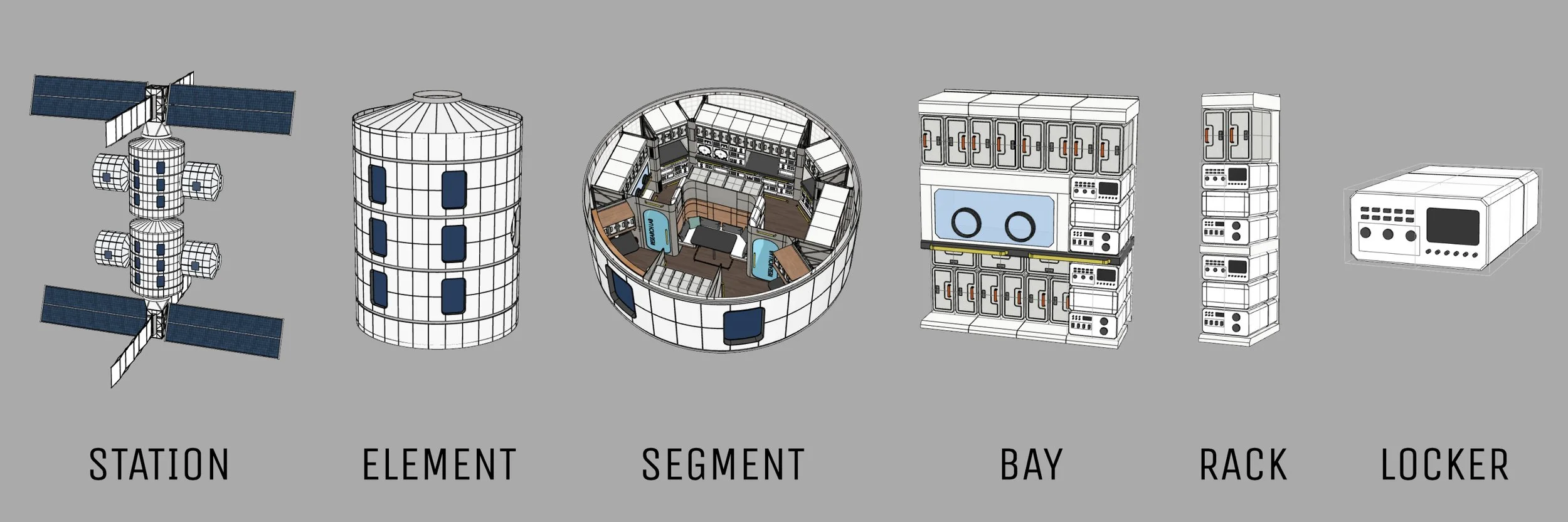
This image is an example of 6 scales of integrated modular design strategies. You can read from left to right and from right to left.
The station is composed of elements connected by a common berthing mechanism that systematizes hatch size and utility connections, not unlike what the CBM does today.
Elements are made up of segments, driven by metallic pressure vessel manufacturing processes and rocket payload fairing sizes. An 8-meter diameter can be supported by Starship and New Glenn 9x4, and a 2+ meter length makes sense as a human-scale “vertical” floor-to-floor height or a “horizontal” cross section with multiple floors. Inflatables are possible, but present a different set of outfitting challenges and must balance volume against usable volume.
Bays are built up from racks, with typical racks and lockers possible but not required. Bays fit into segment infrastructure, standardizing connections to power, data, fluids, and can accommodate unique equipment, amenities, work stations, and window viewing.
Utility integration can extend to racks and lockers, but can also support station system equipment on the same modular grid, increasing overall extensibility. The grid has a minimum atomic size, even within the locker dimensions, but also builds up to generate the coarser systems of organization, the way lab casework fits into a building’s structural grid.
A good modular system is designed to increase standardization, but also enables interchangeability and variation. The framework is not just physical but tied to standards and requirements to help ensure commonality across otherwise dissimilar systems. The goal isn’t one bespoke space station module, but a flexible system within which families of space station systems are developed in parallel and system integration is part of the design.