Three Ways Architecture Can Support Microgravity Research
We’re starting to see a genuine economy developing in low-Earth orbit. Space provides access to resources that can be difficult or impossible to get on Earth, whether communications, Earth remote sensing, near continuous solar power, or access to microgravity.
While the microgravity environment wreaks havoc on the human body, it also provides an unmatched opportunity for scientific research and discovery with applications from pharmaceuticals to microelectronics. Take a look at more of the benefits in this Payload article from last December: https://payloadspace.com/op-ed-congress-must-act-to-prevent-gap-in-microgravity-research/
So what can architects, famous for working within the confines of gravity, do to support this work?
Architects are not building specialists, they’re design generalists, usually with years of educational and professional experience in figuring out how to bring complex, technical design ideas into the physical world. Here are 3 ways they can add value to microgravity research:
1. Modular Design. Buildings are systems of systems and are often built comparatively quickly because of the modularity of those systems, which can be as simple as standard dimensional lumber and as complex as unitized curtain wall systems. Modularity can similarly accelerate in-space science by creating a context of standardized plug and play systems. Imagine a standard kit of parts that ranges from a payload locker up to a space station element, supporting industrialized processes on Earth and reconfigurability in space.
2. Human-Centered Design. Architecture is ultimately for people and architects intuitively design with humans in mind. Whether in space or in buildings on Earth, labs designed to enable researcher comfort, productivity, happiness, and well-being lead to better science outcomes.
3. Lessons from Lab Buildings. State of the art research labs on Earth are more than efficiently packed bench tops. They are multi-purpose facilities that are designed to encourage collaboration, provide amenities, and support a variety of approaches to working. Labs in space go a step further to also provide housing. Addressing the resulting interior zoning, program adjacencies, interrelated program elements, and packaging efficiency challenges, while also creating a nice place to work and live, are exactly what architects do best.
The future of living and working in space doesn’t need to look like the past. For more on this type of work, visit our case study page: the-space-age.com/work/leolabs.
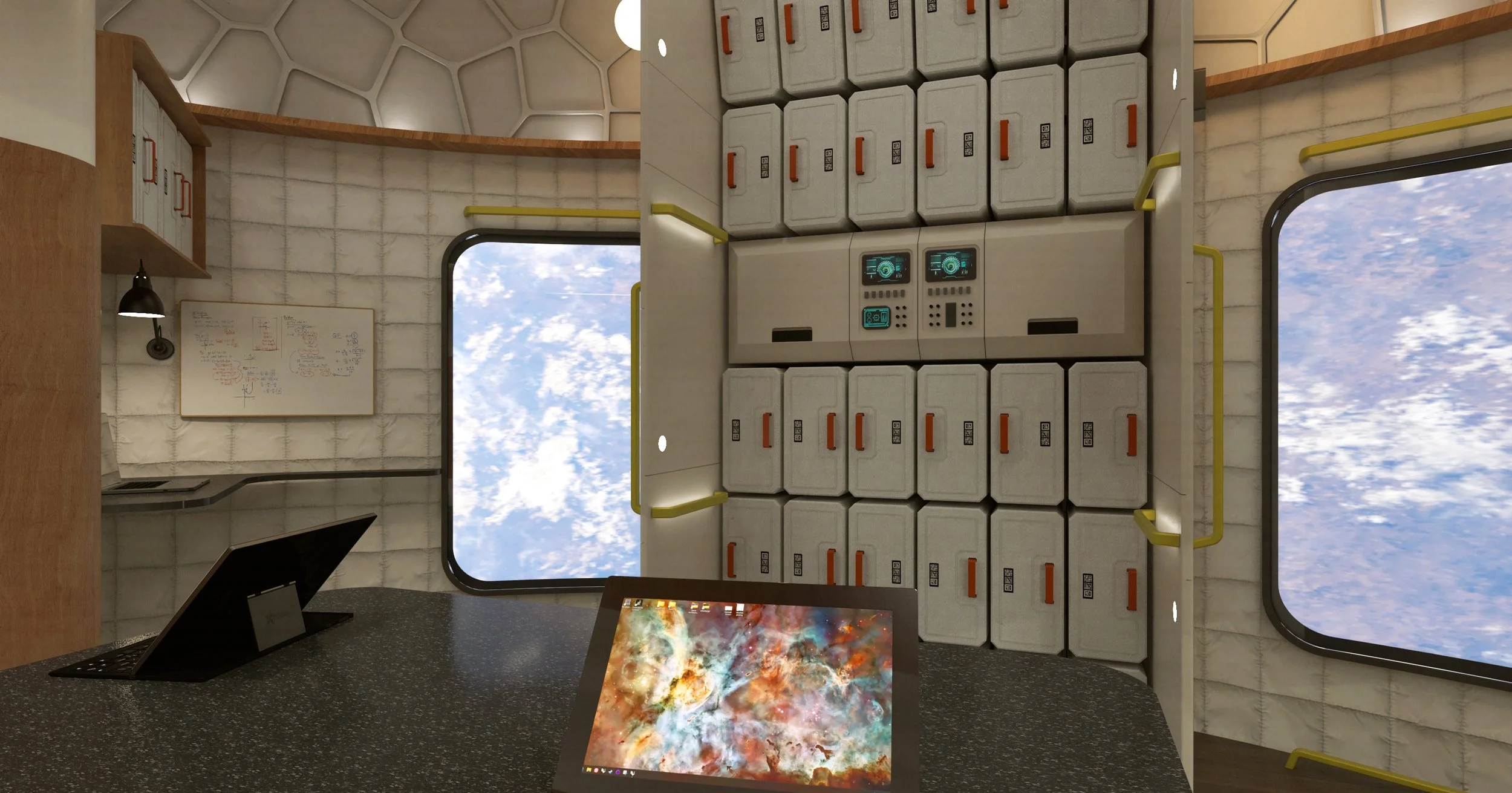
Alternative work spaces in an orbiting lab module