Project Delivery Across Fields
When I started working in the space industry on NASA contracts, I was introduced to the way aerospace programs organize and schedule their work. Once I untangled all the acronyms and figured out what was being asked of our teams in each phase, and what needed to be delivered at each milestone, it became clear that I had done a lot of this before. Delivering architecture projects follows a similar framework: project delivery is broken into a series of phases with gating work product deliveries that often align with payment milestones.
Whether it’s an architecture project or aerospace program, if you zoom out far enough you’re trying to do more or less the same thing: get a large team of people to work together to build something large and complex that’s defined by many technical challenges.
Two things struck me while making this chart comparing the two processes. First is that the phases align pretty well, though not perfectly. Schematic Design in architecture probably encompasses Pre-Phase A and Phase A in aerospace, up through SDR or even PDR. After that, the rest of the design phases get messier, driven by building projects working toward a design intent construction contract and flight programs going directly into fabrication and manufacturing.
The second interesting thing to me is that architectural work stops when the client occupies the building. While architects often do their best to incorporate sustainable practices, manage carbon footprint through supply chain and operational approaches, and consider the end of life of buildings, these are not necessarily an explicit part of the contract and the architect’s role generally ends when the built project is delivered. This is structurally different in an aerospace program’s life cycle, where defined operations and closeout phases consider decommissioning and disposal.
There are some normative takeaways here, and some questions. Should architects be considering operations or decommissioning as part of their deliverable? Does aerospace stand to gain anything by reducing the complexity of its review process? This is one of those funny places where there’s a clear crossover between architecture and aerospace, and likely lessons to be learned on both sides. But there are so few of us with experience in both that discourse can be a challenge. I’m curious what others think.
Sources: https://www.aia.org/resource-center/defining-the-architects-basic-services; https://www.nasa.gov/reference/systems-engineering-handbook/
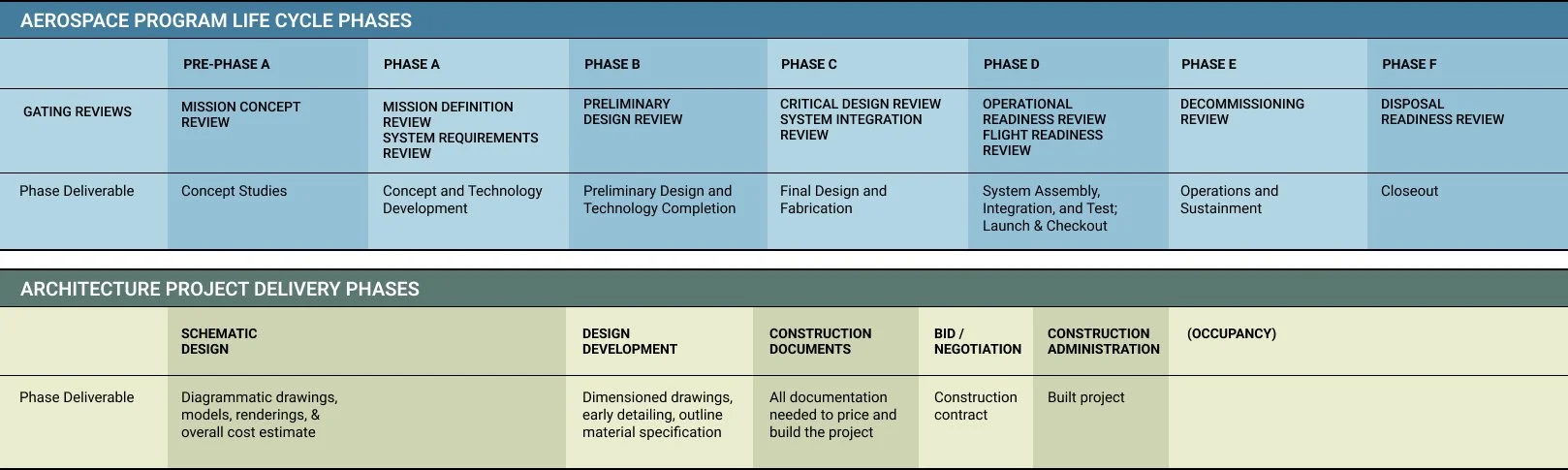
Comparison of aerospace program and architecture project phases